This article appeared in the March 6, 2026 edition of The Film Comment Letter, our free weekly newsletter featuring original film criticism and writing. Sign up for the Letter here.
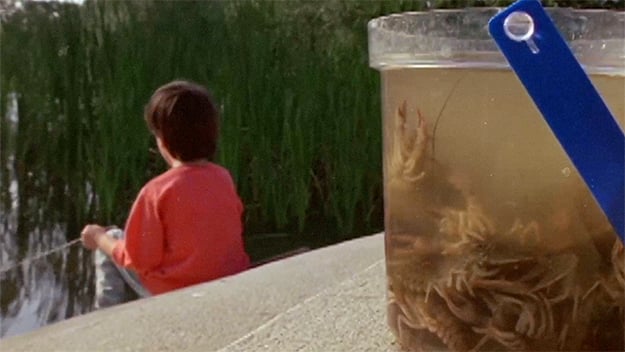
Remake (Ross McElwee, 2025)
Since Ross McElwee’s 1985 breakthrough Sherman’s March, in which he narrated his bumbling search for a girlfriend alongside reflections on the modern American South, the documentarian has honed a wry, understated form of first-person cinema. Turning the camera on himself and on those around him, he’s repeatedly observed his domestic life and the larger world with keen humor and gentle detachment.
Time Indefinite (1993) documented his first marriage, to Marilyn Levine, and the birth of their son, Adrian. In subsequent films, we watched Adrian grow from adorable and adoring son to restless teen; in Photographic Memory (2011), we saw him as a young adult struggling with addiction. Tragically, Adrian died of a fentanyl overdose in 2016 at 27 years of age.
“I used to be a filmmaker,” McElwee tells us at the start of Remake, his first documentary since Photographic Memory. Much of the film is a letter to his son—a letter filled with love, regret, and unanswered questions. Remake is as emotionally devastating as it is intricately layered. Employing the metaphor of a film whose reels are projected out of order, Ross takes us on a dizzying trip back and forth across the decades, journeying through his filmography, Adrian’s own video projects (much more kinetic and rambunctious than his father’s), and the young man’s entire lifespan.
Alongside Adrian’s story, the film also details the absurd saga of a misguided Hollywood attempt to remake Sherman’s March as a narrative feature and then as a TV series; Ross’s bout with brain cancer, which would be a bigger deal in a less tragic film; and his seemingly happy marriage to Korean documentary filmmaker Hyun kyung Kim.
Against all odds, given the rawness of its subject matter, it is a late-career masterpiece by a filmmaker who has indeed found a way to remake himself.
One of the first things that a young Adrian says in the film, as you both are fishing, is how he loves “the deep surprise of the ocean” because you don’t know what you’re going to catch. That speaks to your approach to documentary filmmaking.
It’s such a marvelous phrase, especially coming out of the mouth of someone so young. And yes, it is very much why I embraced this awkward and foolhardy way of making films, where you don’t direct, you don’t script things in advance—you wander into things happening and then see what kinds of deep surprises are waiting. It’s what [documentary pioneer] Ricky Leacock used to call watching a moment bloom right in front of the camera. I’ve never found a good label for what I do. I hate the phrase “personal documentary” because it sounds like a deodorant, but it’s used all the time to describe my work. I do question how much I’ll be able to continue to film like that, because I think there’s also a price to be paid. You are extracting something from other people’s lives to build your own films. I would just hope that somehow what’s gleaned from seeing my films is the filmmaker’s unalloyed affection for the people he’s filming, even if it is exacting a bit of a toll on people’s personal lives.
We see some of this tension when you film Adrian. We see him pull away from you, we see his anger, but we also see his trust in you, in the way he opens up to you when he’s trying to cure himself. And he’s following you, trying to make films; he wants to do what you’re doing, but differently.
Well, I certainly hope that’s how it comes across. I also feel like saying that, yes, I filmed him a lot over the years of him growing up, but it was a tiny portion of our time together. For every minute of filming there were hours and hours where I was with him doing things like playing catch and helping with homework . . . Without the time that I lavished on him [outside of the filming], I don’t think the affection would have been there on his part.
Fred Wiseman died a few weeks ago, and I’ve been thinking about him a lot. You and he are very different in your approaches to filmmaking, but where I think you’re linked is in the way that you edit. Both your films and his are literary in the way they reveal character and tell stories. What’s different with your work, of course, is that you and your family members are the subjects.
I saw Titicut Follies (1967) in a psychology course in college, and I’d never seen anything like that film before. It stayed with me in all of its horrifying resonance. Fred’s work, and those early American documentary filmmakers—Ricky Leacock, the Maysles Brothers, D.A. Pennebaker—were all onto something that excited me. I worked with Pennebaker on his film The Energy War (1979), about the passage of a natural-gas deregulation bill, which sounds like the most boring topic in the world. But it became something really fascinating, both to make and then to see.
I have similar connections to all of these filmmakers. But before I got into photography and film, I was a writer. So creating this persona of someone whose voice was important to a film was something I felt very comfortable doing. It seemed appropriate, in a way, to earn the right to hold a camera and go into the world and film without a real plan, as if I shaped the film with my thoughts and my subjective responses to what I was seeing.
I think your first line of voiceover in Remake is you saying you “used to be a filmmaker.”
That’s meant to be a kind of mournful acceptance of the fact that something’s different now. I don’t say what that is right away. And then you learn in a montage of moments from my son’s life that he’s dead. I didn’t really see how I could continue to be a filmmaker.
How did you continue? You say in the film that making it was a way of keeping Adrian alive. What’s so impressive is how you were somehow able to step back and shape it so beautifully, which must have been so difficult.
It was very difficult. How I turned the corner, to try to make some sort of a film that dealt with the loss of my son, was that I reverted to writing. I couldn’t even begin to go through the films or my diary because it was just too painful. I hired a former assistant to go through all my films that feature Adrian and choose one or two frames from each, beginning with Time Indefinite. Because they were still images, they were frozen. That made it easier for me to think of how I could possibly begin to write about this. I wrote seven chapters, for each of the films in which he’d appeared. That enabled me to break the ice. A year later, I started going through the footage. I was surprised when I saw how much just filming a little bit now and then added up over the years. There was a lot. And my son was front and center in an awful lot of it.
And of course, there’s Adrian’s own filmmaking, which plays an important role in your film. I guess it was tricky to edit his footage.
It was extremely difficult because he filmed some very disturbing things. There were no holds barred—he filmed his friends doing things that were very difficult to watch. He filmed himself at one point while injecting heroin. I couldn’t look at it. I had an assistant editor choose the less difficult footage; I think I was still trying to protect him in a way.
A real question that haunts me is if the filmmaker-father truly loves his son as much as he declares that he does throughout the film, why would he want to make a film in which you see the son spiraling into this dreadful addiction, and how it ultimately affected him and then killed him? Why would you want that captured on film? And why would you want that in what is in many ways a portrait of your son? That’s a hard question to answer.
One answer is that this is the shape of Adrian’s life. You see the entirety of his life in the film, and you had to include this side of his story. I was curious if you were inspired at all by his filmmaking? There are some sections in your movie that use a very inventive editing approach.
Not so much in those passages, those montages, which are more like experimental filmmaking. It’s very unusual to have that in my films. What inspired me about Adrian was his honesty about his own life in the footage that he shot. I felt that kind of honesty is something that, for better or for worse, I do not utilize in my films. I don’t reveal everything that’s going on in my life the way he does. He just had no problem filming everything and revealing what was going on in his life.
The title Remake is so rich. There’s the attempted remake of Sherman’s March, and you’re remaking your other films in a way. You’ve remade your marriage. And one might say a son is a remake of a father…
The primary way that I mean for it to be interpreted is that the film is my attempt to remake my life after losing my son. That doesn’t mean that the grief or the pain goes away. I just accept the fact that you live with that for the rest of your life. But somehow it clears the way for me to move forward again. That’s what I’m going through right now, as I’m beginning to get used to sharing the film with audiences.
In addition to moving forward, there’s also a look back. You sometimes express the feeling that the people you film are always becoming different versions of themselves. You show your first wedding, and talk about how that feels like a fiction now.
I think that’s what I meant by my intention of going back and reassessing the footage I’ve shot. A lot of it at this point does seem almost fictional: is that really me? When people ask me what I think of myself as I grow older and look back on the younger person, especially Sherman’s March, I think that wasn’t me, that was my younger brother. Sort of an asshole.
With Remake, there have only been a few places where I’ve shown the film. And all in foreign countries. So it all has that quotient of being strange and otherworldly. You know, I broke down during a screening in Venice during the premiere. And it still deeply affects me emotionally to watch it.
I wonder how much pushback I’ll get from some of the things we’ve been talking about. A father filming his son. Did that have anything to do with destabilizing him psychologically? Unconsciously leading him into drug addiction? I don’t know; you could argue that. I don’t really think that’s what I’m guilty of, but some part of me thinks maybe I am.
It doesn’t feel like that in the film. Toward the end, Adrian is at a point where he feels hopeless and he’s looking to you to help. When he’s talking to you, one feels like he knows that he’s also talking to the audience that might be seeing this. There is an openness that’s really touching. This is going to sound trivial, perhaps, but are you satisfied with the film? Can you just appreciate it as a work?
It’s hard. With another four or five screenings, it’ll start to become more like that. I’ll allow myself whatever satisfaction is to be had from finishing the film and getting it out there. The editor Joe Bini, who did 20-plus films with Werner Herzog, came in and gave me perspective on the film that I wasn’t able to summon on my own. My producer Mark Meatto stood by me as the film evolved. And my wife was the only person to see the film when it was a rough cut. Those three helped [me] find the objectivity needed to finish the film.
I won’t spoil it for viewers who haven’t had the chance to see the film yet, but the actual, and miraculous, way that Sherman’s March is remade toward the end of Remake is a sign that your film was blessed in some way.
That was insane. And wonderful. And it came out of nowhere.
Like what you catch in the ocean.
Exactly. It takes you right back to the beginning. Where did this come from? The deep surprise of the ocean.
David Schwartz is an independent programmer and writer, and president of the board of directors of the Film-Makers’ Cooperative. He is a guest programmer at the Museum of the Moving Image, where he was chief curator for 28 years, and programmed the upcoming Agnès Varda retrospective at Film Forum.
Source link