With Alpha playing in theaters in New York, I chatted with Ducournau about the film’s key themes: the body, empathy, beauty, and loss.
You’ve spoken about how having doctors for parents shaped your approach to the body. I was fascinated to discover what your parents’ specializations are—is it true that your mom’s a gynecologist and your dad’s a dermatologist?
Absolutely.
Those fields relate in very specific ways to the themes of your films, like gender and reproduction, as well as the skin and the flesh. What did you see growing up that made an impression on you?
If you have doctor parents, you always have magazines and books, so I’ve seen some stuff, especially on the dermatology aspect, that triggered my imagination. But I think that what I keep with me the most is the fact that, in their jobs, there is a constant sense of doubt. We understand why they have to have a cold approach to mortality, to death in general, and to the transformation of the body. But at the same time, this constant questioning implies a great sense of empathy. My parents always told me there is one case per patient, which means that everyone is unique and everyone reacts differently under the same circumstances.
Besides the obvious link with bodily transformation, I think the deep core topic of all my films is unconditional love. How, despite the most dreadful circumstances, there is a place to love someone else, whether they are linked to you or not. And it’s especially in dreadful circumstances—the ones that we are living now or the ones that were happening in the ’90s, as in the case of the film—that this empathy becomes a moral duty.
Something wonderful about the film is that you’re experiencing those events of the ’90s through the eyes of a 13-year-old, who sees things all around her that she does not fully understand. I was wondering if there are certain things you remember about the AIDS crisis from when you were young that left an impression on you, and made their way into the film?
During the peak of the AIDS pandemic, I was between 8 and 15, something like that. What I remember is that no one knew what they were talking about. It wasn’t just that I was young. I felt a total sense of incapacity to take it in, to embrace it, and accept the situation. There was a lot of denial. I also remember the big trauma that was left upon the way we discovered sexuality as teenagers at the time. That impacted my generation very much because we were educated by society that sex was danger. Sex was not healthy. Sex meant that you were doing something profoundly wrong, something very taboo that could kill you or kill someone else. If you think about it, the ’70s were only 20 years prior. We were at the peak of sexual equality and sexual liberation, and it went down in a snap of a finger because of fear and because this huge trauma was never, ever acknowledged.
This denial was made obvious by the fact that the entire world blamed a very specific population and their lifestyle, and decided that they were the scapegoats for this. That was already there. You could feel it. I remember homophobia, xenophobia, as well as acute racism being at a huge peak. Those memories inspired the scene in the classroom where an aggressive student uses a slur to talk to someone he should have respect for—that is, his teacher. One thing that is strange is, I’ve toured a lot already with the film, and I notice that in my younger audiences, some people use the word “dystopian” for that scene. It was actually pretty common and banal. It’s quite a shock to hear that people think that my movie could be set in the future. I always answer that this scene proves that it’s set in the ’90s.
There was a line in the press notes that I really loved. You said you would have felt “it blasphemous to portray the factual symptoms of AIDS, knowing that people would come to the film expecting to be repelled. I wanted to create the opposite reaction.” That made me think about what a clever choice it was to choose marbling as the manifestation of the disease in your film, because it is scary to think of turning into stone, but stone sculptures are also symbols of beauty in art.
To me, the marble represents something more like sanctity. Marble is usually used for saints in cathedrals, and to portray people who are beyond us. So it became a way to elevate to something saintly the lives and the deaths of the people who were deemed less than human. It’s not religious; it’s more my way of trying to hint at a form of reparation, to find dignity and respect for them.
Make them martyrs.
Exactly. At first I thought, I want people to see them as beautiful and I want to make them beautiful. That was naïve because the concept of beauty is never objective. What I find beautiful, people might find repellent. So my take on what’s beautiful was irrelevant, and I could not base the iconography of my film on that.
When I wrote the scene in the waiting room, where Alpha runs into her teacher and his companion, and says “you’re beautiful,” I projected myself into directing the actress and I thought, you have got to tell her that she really means it. It’s not because she’s being polite. We see this from the beginning of the scene because she’s just fascinated by the way he looks; she just stares at him like you would stare at Michelangelo’s Pietà. So when I wrote that, I realized that as long as she sees him as beautiful, everyone will. Her point of view matters more than my point of view.
I know that you are partly of Berber descent.
Yeah, my mom is Berber.
Did you know from the beginning that this would be set in a Berber family?
It was important to me in many ways, because the film is so much about the persistence of love—the strength it can give you, and also the fact that it can generate so much fear in you. As I said before at the beginning of our conversation, unconditional love was something that I wanted to portray very frontally, which was a first for me. In Titane it only happens in the last 15 minutes of the film.
I was struck by the dinner scene, when Alpha, her mother, and her aunts and uncles are all at the grandma’s house. It was so joyful! I don’t think your other films have had a scene like that, which is just so full of… light?
That is what our lunches or dinners looked like in my family during my childhood. This big chaos, this big matriarchy, where women talk more than men, and take a lot of space, and handle everything. There are petty arguments that are overcome by laughter two seconds later, and the just nonstop food coming and nonstop jokes coming.
The question of the family being Berber—it was natural to me knowing that in this film I would have to be more up-front than I had ever been as far as the expression of love and family were concerned. In Titane, my two characters are archetypical figures. I thought about them as gods, Uranus and Gaia. In this film, it’s only raw humanity, no demigods. It’s closer to my experience.
There was never any political aspect to the representation of this family. I noticed afterward that I was asked about it very much, and it left me disturbed. I wondered how much, when you represent a family that is not the standard white family, people need it to be a social or political agenda.
Can you talk about the concept of the “red wind” in the film? Both the idea behind it and the look. It affects the color palette of the film, there’s this beautiful red glow.
There are two things. The first is logical, and the second is about its interpretation. The reason it’s red stems from the scene where Amin’s back disintegrates while Alpha’s mother is examining it. For when the dust starts trickling down, there was the question of what color it would be. Is it white, like you would expect marble to be, or is it red, as you would expect blood to be if it’s calcified? I chose red because if it had been white, then I would have made the patients statues, something that was no longer human. By keeping the blood red and just making it calcified, I keep his humanity.
I’m cautious about imposing my interpretation, because, to start with, it is different from my characters’ interpretation. To the grandma, the red wind represents disease. It represents a form of demon. It’s not that to me at all. To me, it’s about how you keep in your skin the memory of the people that you’ve lost. The wind wipes the hurt away, but at the same time, the dust lingers. It says something about the fact that grieving changes your state of being in the world. Once you’ve lost someone you loved, you mutate into another state of being. But I’m worried about explaining this, because I believe that this is open to anyone’s interpretation and their own experience of grief.
The closing scene, with the storm of red wind, is stunning. I don’t want to spoil it, but it made me think about how grief is a way of insisting that someone or something was real. It’s scary to stop grieving because you fear that if you let go, they won’t exist anymore in the world.
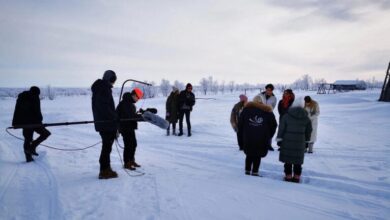
That scene was a big thing because we covered this entire neighborhood in a big layer of red dust, made of red bricks that were crushed. For the production designer [Emmanualle Duplay] and her crew, it took them a week to do that. It was absolutely insane. We also played with big fans in order to have this wind, and this dust coming up. So it was, as is everything that I do, 50 percent practical and 50 percent CGI.
What you said about the scene is very beautiful. That’s exactly why I do not want to impose too much on the interpretation, because you just said something that is very true, through the prism of your own experience, your own subjectivity.
Source link