
Every year, I teach about the Roaring Twenties and the Great Depression, and my students automatically connect the subject to a booming American economy, flappers, and speakeasies. This tends to be their general understanding of the 1920s: that the entire American population enjoyed prosperity and the thrill of challenging social norms. To build my students’ appreciation of the nuances of life in the 1920s, I used documents from the Digital Atlas and TAH to create a group, primary document-based activity that pushed students to think more critically about what actually happened.
We kicked things off with a round of “Social Studies Scattergories.” In groups of three to four, students brainstormed a list of every term, person, event, law–basically anything they could connect to the 1920s. As we progressed through the lesson (featuring documents, images, and graphs), groups earned a point for every term that appeared and was correctly connected. If they had something that didn’t show up but was still accurate, they gave themselves two points! By the end, the group with the most points earned ultimate bragging rights… and the honor of being the true “bee’s knees” of the 1920s…flagpole sitting included, of course!
I created five document sets that included images, graphs, and documents from the TAH collection of the 1920s, for students’ analysis that would build a more complete picture of the 1920s. These sets focused on the automobile, women, farmers, urbanization, and electricity, as well as modernism versus traditionalism.

- Automobiles and the assembly line: This document group includes excerpts from Henry Ford’s Five-Day Work Week and graphs showing the cost of the Model T in comparison to the average annual income. This helps students better understand both the car’s accessibility and its larger economic significance, including the introduction of the five-day workweek. In the Ford excerpt, one argument highlights how additional time off allowed workers to spend more time with their families or engage in activities they enjoy rather than working. Students applied this information to their own lives and considered the importance of their own or their family members’ work-life balance.
- Women in the 1920s: Students read “My Everyday Problems” from Woman’s Home Companion (July 1923). In this publication, readers were asked to write about their daily challenges, and my students were surprised at the range and timelessness of the issues women regularly encountered in the 1920s. The students also examine images of flappers alongside Edith Wilson to draw comparisons and consider differing representations of women during the era. One image they all scream about shows a bathing suit being measured at the beach, which led to a lot of laughter as students imagined how shocking beach “bathing suit inspectors” would be today!
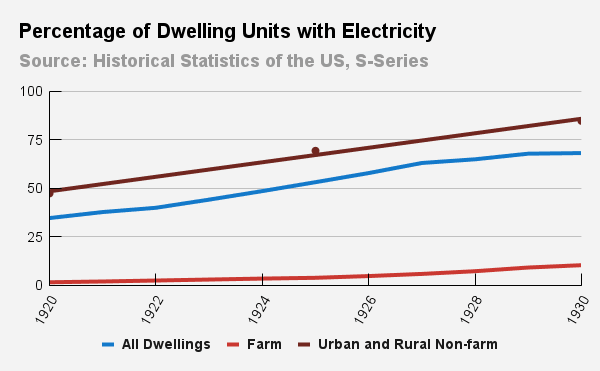
- Urbanization and the introduction of electricity into homes: My students are often surprised when they analyze graphs showing the rapid increase in urbanization and the later adoption of electricity in households. They are just as shocked as they were with the five-day workweek to learn that many homes during this time still did not have electricity. Another graph showing the rise of radios in homes highlights this shift and helps guide our discussion of mass media and its growing influence on society and culture.
- Farmers: This collection highlights that not all Americans benefited from the prosperity of the Roaring Twenties. Students analyze graphs showing the prices of corn and wheat, as well as a chart of the value of agricultural land from 1914 to 1940, which shows the changes in the average value of U.S. farmland per acre. They also examine a chart on farm bankruptcies from 1910 to 1940, revealing the significant economic distress within the agricultural sector during the 1920s. Students also have an excerpt from the Progressive Party Platform of 1924, which outlines the challenges faced by farmers during this period. This is quite the contradiction to the wealth and prosperity typically associated with the 1920s.

After a lively group discussion about the documents, students begin to ask more thoughtful questions about the realities of the 1920s. For their final task, students re-evaluate their initial assumptions and respond to the statement: “The Roaring Twenties was a time of change.” They must take a position, either agreeing or disagreeing, and then support their response with evidence from the documents. Throughout the lesson, students engage with new information, connect it to prior historical knowledge, and draw parallels to their own experiences.
Using TAH documents allows students to develop their own interpretations grounded in primary sources rather than relying on secondary narratives. By the end of the activity, while everyone may still want to be the “bee’s knees,” my goal is to ensure they leave as true “wise heads,” better equipped with a deeper and more critical understanding of the era.

Lauren Goepfert is a graduate of the Master of Arts in American History and Government program at Ashland University. Named the 2018 Madison Fellow for the state of Florida, she now teaches at Longwood High School on Long Island, NY.
https://www.loc.gov/item/2016832965
https://www.tahdigitalatlas.org/map/economy-in-the-1920s
https://www.tahdigitalatlas.org/economic-troubles-in-agriculture
https://teachingamericanhistory.org/document/prohibition-success-or-failure
https://www.tahdigitalatlas.org/map/social-and-cultural-issues-in-the-1920s