This article appeared in the February 13, 2026 edition of The Film Comment Letter, our free weekly newsletter featuring original film criticism and writing. Sign up for the Letter here.
The Misconceived (James N. Kienitz Wilkins)
Though you wouldn’t know it by looking at the festival’s signature Tiger Competition and the lack of conversation around its prizewinners, the 55th International Film Festival Rotterdam was in fact one of the buzziest editions in recent memory. Online chatter about a few off-the-beaten-path titles ahead of the event piqued wider critical interest than usual, while pointing the way for correspondents too often lost amidst the festival’s massive program. In addition to hundreds of new shorts and features, the lineup also included several artists’ exhibitions and retrospective strands, the latter highlighted this year by a selection of 1980s and ’90s V-Cinema (aka direct-to-video Japanese releases)—with at least a few modern masters represented, such as Takashi Miike, Shinji Ayoama, and Kiyoshi Kurosawa. It’s unclear if this glut of options deterred critics from sampling the Tiger Competition features, but either way there was significantly less on-the-ground discussion about the 12-film selection than there has been in recent years, even though it contained a couple of promising titles (namely Shao Pan’s shape-shifting revenge drama Nangong Cheng and Ique Langa’s austere religious parable The Prophet; it’s a shame that neither won a prize). Instead, the most talked-about titles came from the festival’s many sidebars, such as the noncompetitive Harbour and Bright Future sections. As always at IFFR, you had to know where to look.
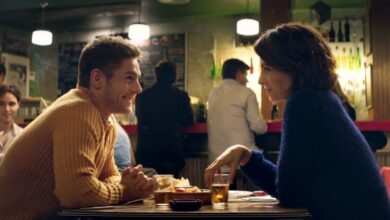
While one would be forgiven for not looking to any festival’s opening-night selection for something of a substantial quality, in the case of João Nicolau’s charming IFFR curtain-raiser Providence and the Guitar, it would be a mistake to underestimate its crowd-pleasing attributes. A riff on Robert Louis Stevenson’s 1878 short story of the same name, the Lisbon-born Nicolau’s fourth fiction feature juxtaposes the Scottish author’s protagonists, León (Pedro Inês) and Elvira (Clara Riedenstein), two married 19th-century troubadours struggling to make ends meet, with a pair of counterparts (played by the same actors) in present-day Portugal, where the characters are now a front man in a rock band and a fan who advocates for social-security reform in her free time. If the fairy tale–like conceit comes off as quaint, or even naïve, Nicolau’s earnest depiction of the creative spirit, equal parts whimsical and ribald, speaks persuasively to the idea that art is not only timeless, but inherently valuable—and thus worth fighting for.
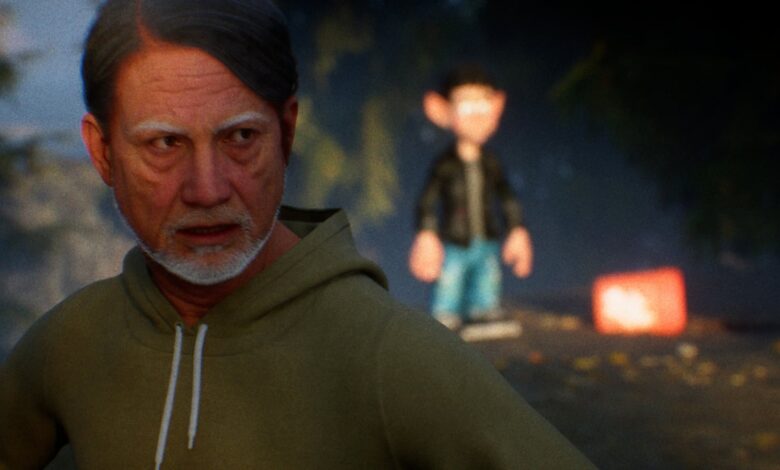
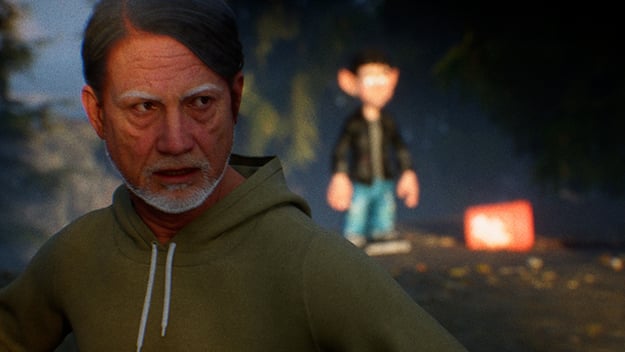
That the festival’s best new features—all at least partially U.S. productions—embody this belief in art for art’s sake in both style and substance is likely less a coincidence than it is a reflection of the state of independent filmmaking. James N. Kienitz Wilkins’s The Misconceived is in large part about this very issue. Initially devised as a live-action follow-up to 2019’s The Plagiarists (directed by Kienitz Wilkins under the pseudonym Peter Parlow), The Misconceived became an experiment in 3D animation and motion-capture technology when the project was rejected by several indie studios. Rendered entirely with the Unreal Engine video-game software, a framework originally created for first-person shooter games that has since gone on to much broader applications, The Misconceived—which, like The Plagiarists, was co-written by Robin Schavoir—picks up with once-aspiring filmmaker Tyler about a decade after the events of the earlier film, which saw his and his girlfriend’s cultural-creative worldview shattered after falling for a stranger’s faux-artist bloviating. Now a single dad in need of employment, Tyler (voiced by John Magary; a variety of cast and crew members did the motion capture work) unwittingly takes a job on a construction team hired to renovate the country home of his college friend Tobin (Jesse Wakeman), a successful sculptor who is happy to offer Tyler condescending advice on a career in the arts. The action transpires almost entirely around the house and during work hours, where differences of age, class, and race among the laborers lead to some hilariously off-color, frequently meta-cinematic quips (references to more commercially successful indie filmmakers; the use of quotes from actual reviews of the director’s prior films) that have become a Kienitz Wilkins trademark. Coupled with its uncanny visuals, The Misconceived’s self-referential millennial humor can occasionally resemble a hall of mirrors: one can easily get lost in its dizzying whirl of citations and innuendo.
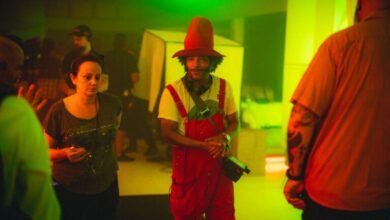
Deploying a more Gen-Z aesthetic, Charlotte Zhang’s Tycoon is a film that could play well on screens of any size—and, given that it was arguably the greatest recipient of that early social-media buzz, it clearly has. Shot almost entirely at night on a combination of iPhone, MiniDV, and Super-8 cameras, the film centers on two twentysomething grifters (played by Miguel Padilla-Juarez and Jon Lawrence Reyes) living in a near-future Los Angeles on the cusp of the 2028 Summer Olympics. The kind of lo-fi transmission that comes along only once or twice in a generation and defines a certain era of filmmaking, Tycoon is a DIY marvel. Which is to say that Zhang, a Canadian visual artist who shot the movie piecemeal over a few weeks with a handful of friends in L.A.’s Pico-Union neighborhood, gets a lot of mileage out of vibes. Indeed, Tycoon has little in the way of traditional plotting; save for a framing device involving a livestock virus and a citywide cockroach infestation, there isn’t much context provided about this quasi-dystopian environment. Through a series of loose vignettes separated by on-screen slogans and punctuated with the occasional street-drifting interlude, we watch as Padilla-Juarez and Reyes hatch petty schemes to make a little money and stay afloat in a city that’s historically mistreated minorities. (Zhang herself was apparently illegally evicted from her L.A. apartment over a roach problem.) With its intermittent inclusion of rapid montage sequences and interest in the plasticity of the digital image—as well as its focus on the economic precarity of young people of color—the movie is reminiscent at times of fellow Canadian Isiah Medina’s 88:88 (2015), which similarly forged a fresh aesthetic corollary for its themes of class, poverty, and dispossession. If Tycoon isn’t as formally radical as that film, it’s just as indelible—a vision of the future that captures something profound about the present.
In Chronovisor, the enigmatic object that gives the film its title is said to have captured ancient images of a world-historical import, such as Christ’s crucifixion. The alleged existence of this contraption, a kind of time-traveling cinematograph, which the real-life Italian Benedictine musicologist Pellegrino Ernetti claimed to have invented with a team of 12 scientists in the mid-20th century, fascinates the film’s fictional main character, a Columbia philosophy professor named Béatrice Courte (Anne-Laure Sellier), who goes down a rabbit hole of conspiracies related to Ernetti and a supposed cover-up by the Vatican. Shot on 16mm and set primarily in libraries and other dimly lit academic spaces, this astonishingly original movie by first-time feature directors Jack Auen and Kevin Walker (co-founders of the New York production company and filmmaking collective Cosmic Salon) began as a documentary about Ernetti but blossomed into a nearly unclassifiable hybrid that spins a fabricated narrative about the thin line between research and obsession. It’s how Auen and Walker present this true story of paranormal intrigue that inspires fascination. Told primarily via textual ephemera—from actual newspaper articles, scholarly journals, and books—the film unfolds from Courte’s perspective as she reads through these materials. Superimposed translations of specific excerpts, left glowing atop the original words, call upon the viewer to follow along as reams of information are literally transmitted from page to screen. Rare is the movie outside the experimental-film world that demands such sustained engagement with what amounts essentially to a text-based narrative; much of the fleeting dialogue scenes involve Courte either talking with colleagues over dinner or trying to track down more information about Ernetti and his cohorts over the phone. It’s a quietly provocative gesture, and the results are enrapturing. Like the best of this year’s IFFR, Chronovisor suggests a new kind of visual storytelling—one in which traditional film language takes a back seat to a more fluid mix of mediums and methodologies.
Jordan Cronk is a film critic and the founder of the Acropolis Cinema screening series. He’s a member of the Los Angeles Film Critics Association and a program advisor for the Directors’ Fortnight section at Cannes.
Source link