This article is part of Film Comment’s Best of 2025 coverage. Read all the lists here.
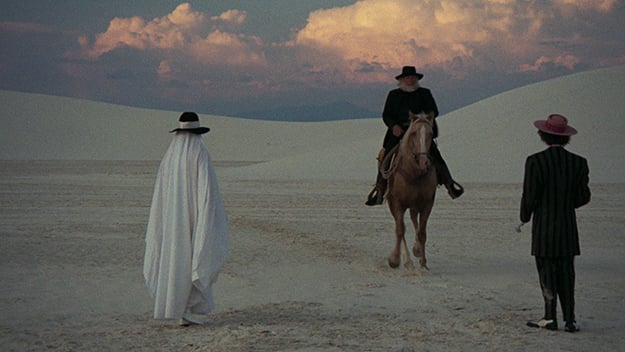
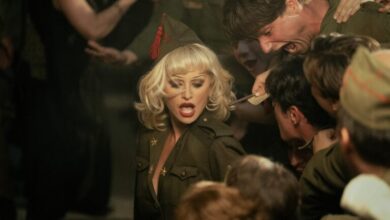
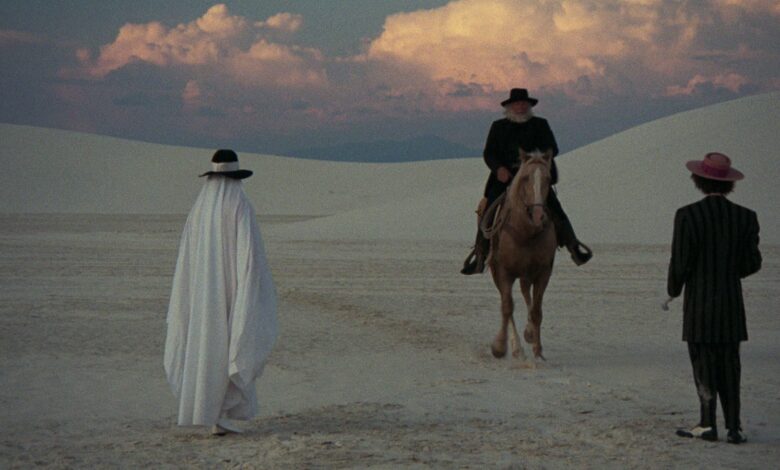
Greaser’s Palace (Robert Downey Sr., 1972). Courtesy of Anthology Film Archives.
There were more new 4K restorations released in 2025 than I, or anyone, could ever hope to see. As such, it’s important to note that this list is limited to both what screened in New York City, where I live, and what I was able to catch. In my viewing I tended to prioritize projects that honored the original projection format of the movie (most often celluloid), and films that were fiercely independent, international, transgressive, or rarely screened. That said, I believe that everything on my list is truly deserving of a new audience, and that the work of the organizations and individuals behind these restorations is nothing short of heroic.
Greaser’s Palace (Robert Downey Sr., 1972) and Sticks and Bones (Robert Downey Sr., 1973)
Anthology Film Archives presented two of the most important restorations of this year, both films by the late, great Downey Sr. The work done on his surrealist western Greaser’s Palace was reportedly a seven-year effort—it took longer than expected to get the color right—that had been initiated after the original 35mm negative was miraculously rediscovered in 2017. A new 35mm print of that restoration premiered at Anthology this past October.
On the other end of the spectrum, Downey’s Sticks and Bones, a made-for-TV project commissioned by CBS, was long thought to exist only in a version with burned-in timecodes. When a 2” master videotape belonging to cinematographer Peter Powell was discovered, Anthology was able to preserve and present the film in a series devoted to Downey Sr.’s mid-career work. Made-for-TV films, which often have complicated rights issues and/or missing materials, are highly at risk, and each one that is preserved and restored is worthy of celebration.
Mortu nega (Flora Gomes, 1988)
Gomes’s debut feature, a structurally invigorating meditation on revolution, was restored as part of the African Film Heritage Project. The initiative, created by The Film Foundation’s World Cinema Project, the Pan-African Federation of Filmmakers, and UNESCO, in collaboration with Cineteca di Bologna, continues to bring lost masterpieces—an overused term that I don’t employ lightly—back to life. That metaphor is especially apt here, as the English translation for Mortu nega is Those Whom Death Refused.
Memory Lane (John M. Stahl, 1926)
In her introduction to Stahl’s comedic and tragic love triangle at the Museum of Modern Art’s annual Silent Movie Week, the Library of Congress’s Rachael Stoeltje very matter-of-factly explained that the new 35mm print that was being projected will last for 700 to 900 years if stored properly.
Dying (Michael Roemer, 1976)
Commissioned by Boston’s public television station WGBH, this poignant and candid documentary by Roemer—who passed away this year at the age of 97—offers the points of view of those in the process of dying of terminal illnesses. Now that the original 16mm print of his film has been restored in 4K thanks to The Film Desk, it will be able to reach many more people than it did upon release.
Black Girl (Ossie Davis, 1972)
Davis’s film about a young Black woman with dreams of escaping poverty and becoming a dancer, based on the hugely successful stage play written by J.E. Franklin, played three times at this year’s New York Film Festival, and each screening was sold out. It was presented on a new 35mm print, thanks to the dedicated work of the UCLA Film & Television Archive.
Will (Jessie Maple, 1981)
The debut feature by Maple, the first Black woman to join New York’s camera operators union, was an independent production shot on 16mm with a budget of $12,000. This compassionate study of addiction and recovery originally screened independently in community centers, churches, and educational institutions thanks to LJ Film Productions, the company Maple operated in collaboration with her husband, Leroy Patton. It has since been preserved by Indiana University’s Black Film Center & Archive.
Shock Video (Ken Camp, 1985)
This year, EZTV—an LA-based production co-op and ahead-of-its-time “microcinema” that started offering weekly programming in the early 1980s—was celebrated with retrospectives in New York and Los Angeles. As part of these programs, Elizabeth Purchell’s Muscle Distribution, a distributor of “scrappy, misfit films that don’t fit into any particular box,” independently restored the works of the pioneering queer filmmaker Ken Camp, including Shock Video, an intense and incredibly dark 12-minute trailer of sorts for an unfinished Super-8 horror feature called After the Comet.
The Arch (T’ang Shushuen, 1968)
Source link