This article appeared in the April 3, 2026 edition of The Film Comment Letter, our free weekly newsletter featuring original film criticism and writing. Sign up for The Letter here.
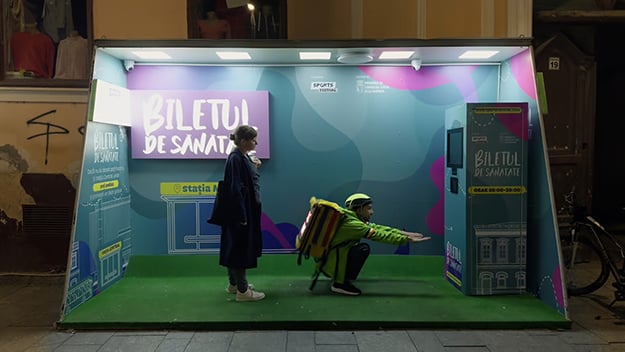
Kontinental ’25 (Radu Jude, 2025)
In an interview conducted when he was making Europa ’51, Roberto Rossellini defined Italian neorealism as “a response to the genuine need to see men for what they are, with humility and without recourse to fabricating the exceptional.” For Rosselini, this meant building his films out of the unvarnished material of the everyday: postwar Italy’s impoverished people, and the social and spiritual problems that emerged from their lives. The title of Radu Jude’s Kontinental ’25 indicates its debt to neorealism in general, and its borrowings from the plot of Europa ’51 more specifically. This initially seems incongruous, given Jude’s reputation as one of the more satirical, hyperbolic, and media-addled of contemporary filmmakers. But Kontinental ’25 is a neorealist film, one attuned to the everyday without fabricating the exceptional—it’s just that in the present day, the everyday is pretty exceptional (and quite frequently fabricated).
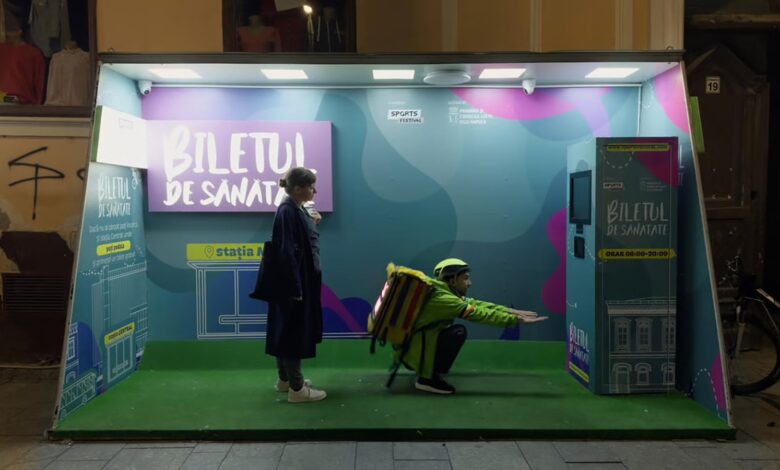
Unlike that of Rossellini and his contemporaries, daily reality for Jude involves screen time, and probably too much of it. In a more subtle way than his despairingly A.I.-infected Dracula (2025), Kontinental ’25 is a case study: shot on an iPhone in 10 days, the film constantly punctures its narrative with TV broadcasts playing in the background, viral videos streaming on phones held up to the screen, and characters reading comment sections aloud. And where the aesthetic of the Italian neorealists drew from the documentary tradition, Jude’s neorealism extends to shooting raw material in a raw style, with natural light and an unmanicured mise en scène, giving his frame a flattened, open digital look that evokes the way we see the world through our devices.
Kontinental ’25 opens on Ion (Gabriel Spahiu, Dracula’s Vlad the Impaler) picking up bottles and rubbish and muttering to himself as he walks through a wooded area that, we learn through a startling cut to an animatronic baryonyx, is, in fact, Dino Park, at the Wonderland Resort in the Transylvanian city of Cluj. Ion walks through the city, along highways dotted with presidential billboards, begging for work or money, and enduring harassment from a remote-controlled robot dog. He lives in the basement of an otherwise unoccupied building, whose absentee owner has apparently sold it to a politically well-connected company, called Europa, with plans to raze the building and erect a luxury hotel. Orsolya (Eszter Tompa), a bailiff assigned to evict the elderly alcoholic squatter, and the gendarmes who are there for backup give Ion a few minutes to gather his belongings. While they’re finishing their cigarettes, he strangles himself with a length of wire, choosing death over living in the streets.
The suicide sends Orsolya into a spiral of self-questioning and a quest for absolution, carried out in dialogues with friends, colleagues, and family. She is Jude’s version of Irene in Europa ’51, played by Ingrid Bergman—a wealthy mother whose sudden bereavement leads her to forsake her privilege and devote herself to the poor. Through intense exchanges with leftists, priests, and other authority figures, Irene develops class consciousness and a Christian cosmology, but she also synthesizes and transcends these worldviews, with actions born of pure altruism and universal love. Europa ’51 is, by design, dialectical and didactic, pointing the way to Rossellini’s later, “educational” historical films, in which he aimed to “show the customs, prejudices, fears, aspirations, ideas, and agonies of an epoch and a place.” “Confronting a man with his time,” Rosselini maintained, “gives me enough material to construct action and incite curiosity.”
Kontinental ’25, in contrast, extends Jude’s primary project in his narrative films: confronting a woman (it is always a woman, from 2018’s I Do Not Care If We Go Down in History as Barbarians to 2023’s Do Not Expect Too Much from the End of the World) with her times, even as the “material” of these times—reactionary politics, propaganda, shortened attention spans, avaricious transnational capital, open sexual pathology—has become so overwhelming that the clarity of action and purity of curiosity modeled by Rossellini is likely to be swamped. Unlike Rossellini, whose characters directly confront his society, Jude’s characters speak in stories, quotations, and koans; their serious political conversations about the issues of the day digress into esoteric grievances or upsetting racist jokes. Jude gets politically incorrect kicks when people reveal their fixations in conversation—but, more to the point, he presents a world full of such unreliable narrators that it is nigh impossible for his heroines to chart a moral course through all the noise.
In previous films, Jude’s women, laboring at jobs that embedded them in the cruelty of their society, have resisted through acts of anger and absurdism. Orsolya’s anguish is more acute and self-abnegating. Her protestations of “Legally, I am not at fault” feel hollow: she’s aware of the corruption driving her city’s gentrification, but her acts of resistance go no further than off-loading winter evictions onto her colleagues. Her crisis of complicity after Ion’s suicide is answered with indifference and acquiescence from all quarters. When she unburdens herself to her husband, he looks up a news article about Ion’s death, and tells her with ironic detachment about the racist things the website’s readers are saying about her (Orsolya is ethnically Hungarian, a demonized minority in Romania); then, he tries to initiate sex. Her boss dismisses her feelings of responsibility by comparing her, with breathtakingly anti-Semitic phrasing, to Oskar Schindler. Even a priest consoles her by telling her that suicide is a sin.
Each confidante reveals their own biases. Orsolya’s mother is an Orbán supporter who relishes her own stereotypes of Romanians. A well-intentioned friend tells Orsolya a long story about an unhoused man stinking up her apartment complex, and how she found it impossible to do anything to help except call the cops, before comparing notes on which NGOs they each support. (Orsolya adds a couple Euros to her monthly phone bill for various causes—papal indulgences for a neoliberal era.) A former student (Adonis Tanța) from her days as a law professor gets her drunk, tells her funny Zen jokes about the pointlessness of existence, shows her a video of a Russian soldier dying in Ukraine, and then seduces her shamelessly.
Many of Jude’s films re-create what I’ve been told is the experience of being a woman online: an infinite scroll of harassment, reposted memes and aphorisms, atrocity videos, and the competing claims of various good causes. In the past, Jude’s women, even when flawed and abrasive, have seemed noble in their opposition to the indignities of life under capitalism, and near saintly in their endurance of sexism—so superior to their circumstances as to resemble the radical, radiant Bergman of Europa ’51. Orsolya’s positioning is more complicated. She is the picture of liberal concern; her genuine anguish at the world’s injustices does not preclude the occasional selfish decision or tone-deaf pronouncement (she complains that her neighborhood, a new suburb, is becoming so overcrowded it’s starting to look like China), making her an intriguing evolution of Jude’s female archetype, now both victim and victimizer. The world she lives in is so gamified that posting is what passes for praxis; it makes a virtue of her outsourcing her conscience to largely symbolic gestures, like frowning with her friend at smartphone pictures of the poverty on Cluj’s outskirts, or maybe, if she’s truly serious, changing careers.
The Romania of Kontinental ’25 is being busily overwritten by the bloblike, unaccountable fixtures of international capital: Jude regularly inserts transitional shots of shoddy new high-rises, presumably built by the real-life equivalents of the “Europa” that evicted Ion, that are now springing up over Cluj’s cemeteries and around banners advertising American chain restaurants. Orsolya, who has a new apartment in one of those developments to pay for and two children to look after, sees no evident means of extricating herself from the slop of the contemporary everyday, and this darkens the tone, and dampens the spirit, of Jude’s critique. Rising out of the rubble of a war-ravaged Italy, and imbued with the utopian possibility of religious faith and political idealism, Europa ’51 is a lesson in morality. Jude’s neoliberal-era answer to neorealism is a study in nihilism.
Mark Asch is the author of Close-Ups: New York Movies and a contributor to Reverse Shot, Screen Slate, Filmmaker, the Criterion Collection, and other publications.
Source link