Women and men are almost equally as likely to be diagnosed as autistic by adulthood, new study finds

According to the U.S. Centers for Disease Control and Prevention, boys are about three times more likely to be diagnosed as autistic than girls are. Scientists have sought an answer as to why that imbalance exists: some have argued it is to do with male and female brains; others have proposed that genetic differences or some other biological factor could hold an answer. And there is evidence that some girls and women are misdiagnosed—or missed altogether.
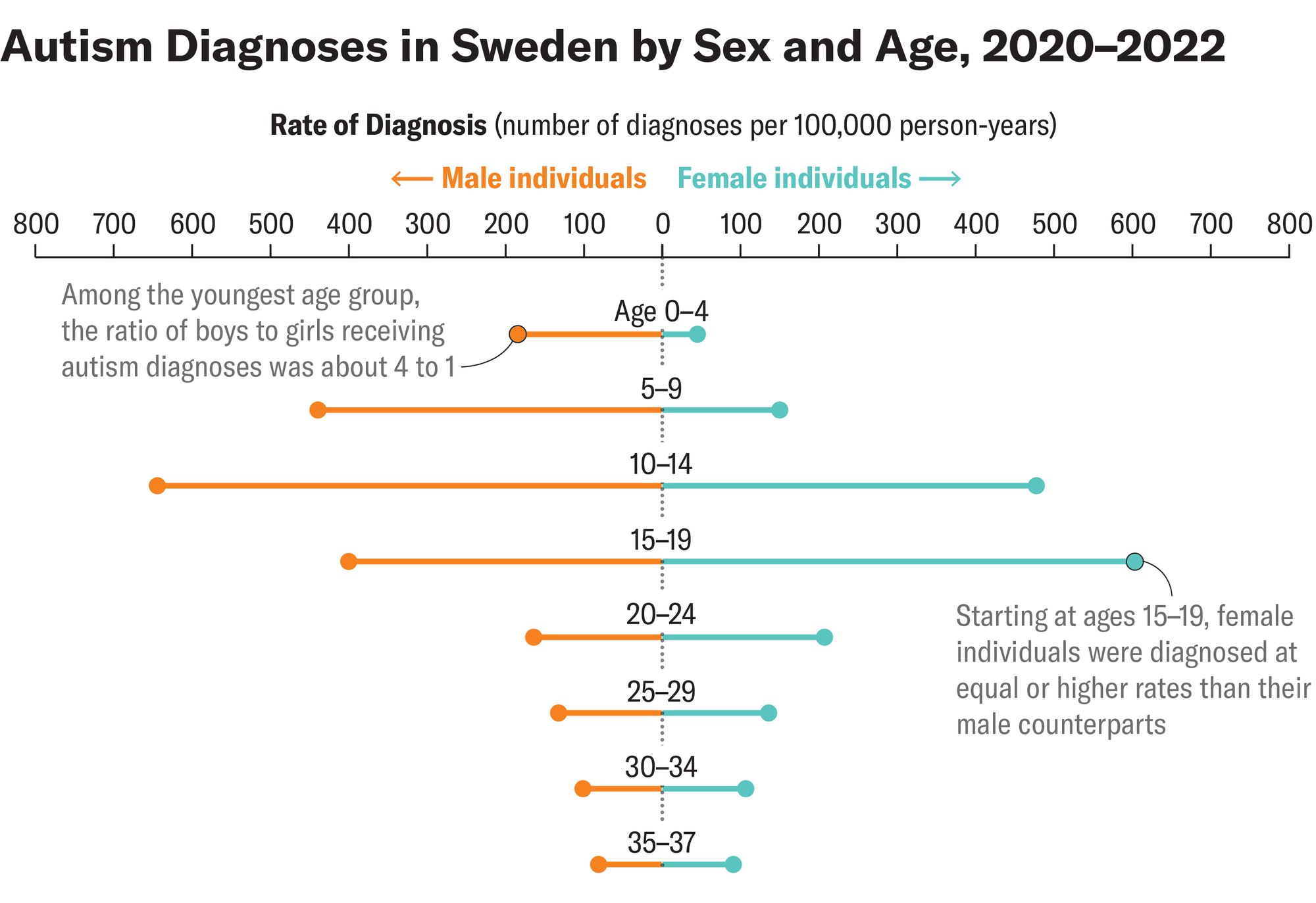
But a new study involving millions of people in Sweden shows women and men are almost equally as likely to be diagnosed with autism by adulthood—suggesting younger girls may be underdiagnosed and possibly missing out on critical care.
Scientists followed 2.7 million children born in Sweden between 1985 and 2020, about 2.8 percent of whom had been diagnosed as autistic by 2022. In early childhood, boys were much more likely to receive an autism diagnosis. But as the cohort aged, the researchers identified a “catch-up” effect—by age 20, women were almost just as likely to have received an autism diagnosis as men. The research was published in the BMJ.
On supporting science journalism
If you’re enjoying this article, consider supporting our award-winning journalism by subscribing. By purchasing a subscription you are helping to ensure the future of impactful stories about the discoveries and ideas shaping our world today.
The study is “interesting” and “well done,” says David Mandell, a professor of psychiatry at the University of Pennsylvania, who points to the study’s 35-year period and extensive dataset.
Gina Rippon, a professor emeritus of cognitive neuroimaging at Aston University in England and author of the book The Lost Girls of Autism, agrees. The results are “powerful” and “sound,” Rippon says. “This is a really rigid, perhaps classically Scandinavian-type study, where the data is amazing data, collected over time, valid, reliable, etcetera.”
Indeed, because the study relied on clinical diagnoses, its findings may in fact be a “conservative” estimate of autism rates among women, she adds.
It’s not totally clear what may be driving the early diagnosis gap between boys and girls. One possibility is “systemic biases in diagnosis,” wrote patient and patient advocate Anne Cary in a related BMJ editorial. In other words, the way clinicians diagnose autism may be missing girls. Girls, “out of instinct or necessity,” may also be masking the condition.
And that has real consequences. Delayed diagnoses can mean that autistic people have to work harder to get the right treatment and may be misdiagnosed with conditions like anxiety or ADHD in the meantime.
Rippon says the new study may be a step toward correcting that legacy. “If this study does nothing other than indicate what is going on in the recognition of autistic women, then that will be great,” she says.
It’s Time to Stand Up for Science
If you enjoyed this article, I’d like to ask for your support. Scientific American has served as an advocate for science and industry for 180 years, and right now may be the most critical moment in that two-century history.
I’ve been a Scientific American subscriber since I was 12 years old, and it helped shape the way I look at the world. SciAm always educates and delights me, and inspires a sense of awe for our vast, beautiful universe. I hope it does that for you, too.
If you subscribe to Scientific American, you help ensure that our coverage is centered on meaningful research and discovery; that we have the resources to report on the decisions that threaten labs across the U.S.; and that we support both budding and working scientists at a time when the value of science itself too often goes unrecognized.
In return, you get essential news, captivating podcasts, brilliant infographics, can’t-miss newsletters, must-watch videos, challenging games, and the science world’s best writing and reporting. You can even gift someone a subscription.
There has never been a more important time for us to stand up and show why science matters. I hope you’ll support us in that mission.
Source link