This article appeared in the January 16, 2026 edition of The Film Comment Letter, our free weekly newsletter featuring original film criticism and writing. Sign up for the Letter here.
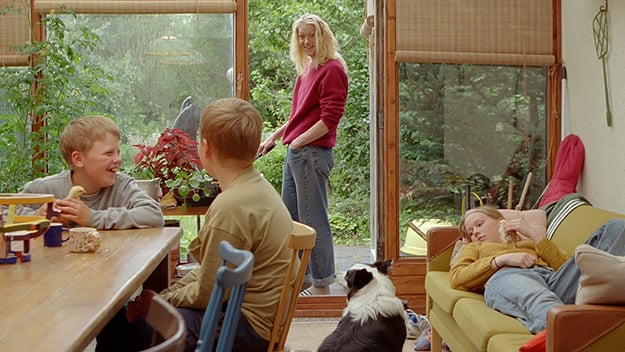
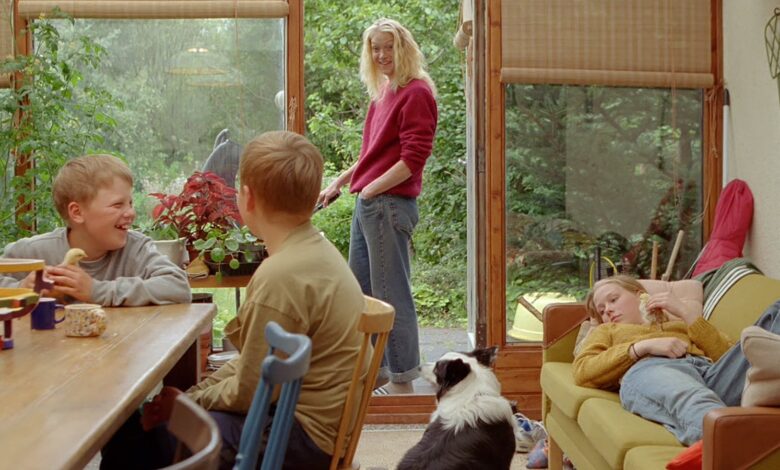
The Love That Remains (Hlynur Pálmason, 2025)
Since Hlynur Pálmason’s 2017 debut feature Winter Brothers, the Icelandic director has proven himself to be an idiosyncratic and versatile auteur—dabbling in a wide range of genre conventions from social drama to romance, policier to historical epic—while also developing a distinctive style and preoccupation with the nature of time. The four features he has made so far each feature his signature time-lapse sequences: he places his camera at a static point of observation, sometimes for months on end, then condenses the resulting images into arresting montages that reflect on the stark Icelandic countryside and the passage of the seasons.
Expectations were high after 2022’s breakout Godland, a sprawling exploration of Danish colonialism and Christianity in 19th-century Iceland, which premiered to international acclaim in the Un Certain Regard section of the Cannes Film Festival. His decision to follow such an ambitious work with something as intimate, restrained, and wistful as The Love That Remains may come as a surprise, but only at first glance. Following the lives of Anna (Saga Garðarsdóttir) and Magnús (Sverrir Gudnason), a recently separated couple co-parenting their three children while navigating life beyond marriage, The Love That Remains is an epic in its own right—a deeply poetic homage to lingering feelings, the many shapes affection can take, and the role that art and dreams play in our everyday lives.
I caught up with Pálmason at Les Films de Cannes à Bucarest, a yearly retrospective of the highlights of Cannes founded by Palme d’Or winner Cristian Mungiu, which last year presented a small focus on Pálmason’s films. We discussed his cinematic signatures and open-ended working process, and the influence of canonical painters such as Claude Monet and Eugène Delacroix on his artistic techniques and worldview.
It’s surprising to see you go from a film like Godland to something that’s so much more intimate. There were hints that you were working on a film like this in your 2022 short, Nest, which follows three siblings—played by your own kids, who also appear in The Love That Remains—building a tree house over the course of a year.
Nest prompted me to begin taking The Love That Remains seriously as my next project. Because I spent two years filming my kids and this tree house, I spent much time inside a small shed, reading books or waiting for animals to come into the frame. And while I sat there, I started thinking: what are the parents of these children doing? So, I started writing a small narrative for them. However, the first thing that we shot for The Love That Remains was in 2017—the image of the roof that opens the movie. That was before Godland.
When we moved our family from Denmark to the countryside of Iceland, we bought our own film camera and accessories. I just keep the camera in the car every day and film whatever I want. This is how I construct and build my films—using the material I’ve already shot instead of writing the whole thing. I’m always shooting and then reacting, and that material is dictating what direction I’m going in.
There’s a playful critique of masculinity in The Love That Remains, following similar threads that are explored in Godland but in a very different way. For example, there is this beautiful scene when Magnús looks up Anna’s skirt where you play with the idea of the male gaze. In most films, this scene would come off as sleazy, but you transform it into such a tender and loving moment.
Being a male, I’m fascinated by these things—these basic, primitive needs and wants. I remember, early on, when we did the under-the-dress scene, someone on the team said it might be read negatively. It depends on how you do it. If it’s done with the naïve joy of beauty, then it will be expressed that way.
Your films have a very distinctive signature: the time-lapse sequences that you’ve used in the opening shots of A White, White Day (2019), in the closing sequence of Godland, and even as the structure of the entire film in Nest. In The Love That Remains, these scenes are spread throughout the film and feel somehow more self-aware and deconstructed.
I’m really interested in the seasons and the temperament of the weather: the beauty and the brutality of it, these contrasts of cold and warm, stillness and storm. I use them almost like a palette for painting, to balance the film. If there is a difficult period in a film—for example, with The Love That Remains, when it starts to become violent or dangerous, or when the relationship is sort of going sour—I can use images that lift those feelings. I use them as emotional colors in the film.
When you’re watching a film and you can feel time passing, for me, the film becomes more real. It’s like seeing something grow. It’s very emotional. I am still exploring it. I think that the next film will be the ultimate, like it will be indulged in time and space.
Those scenes remind me of the work of Monet, particularly his explorations in his garden.
It connects a lot to Monet. I remember being very inspired by the paintings and diaries of Delacroix and Paul Klee, and by much of the writing of Per Kirkeby, a Danish painter. And there’s one Spaniard from Catalonia, [Antoni] Tàpies, who wrote two memoirs. When I read these books and then saw their paintings, I responded powerfully to the very mundane things they depicted— like when they were just painting their kids taking a bath, the food they were going to eat over the weekend, or a bottle of wine. I felt emotionally stimulated by them. I felt it was beautiful, that it had to do with the ups and downs of life.
When I read their diaries, they were very normal, down-to-earth, too. “Okay, how much money do I have left to buy food? How much money do I have to buy paint? What colors am I going to buy? How is the weather outside? Is it cold? How is my health? How do I feel?” I connect with these kinds of things because it shows that, as human beings, we don’t change that much. We are the same, whether in the time of Delacroix or today.
How much were your children involved in creating their own scenes? The film borrows a lot of the kids’ humor, and it’s very authentic, very faithful to the feeling of being a child.
If something is very free, then you don’t know if it’s improvised or constructed. I’m a big fan of John Cassavetes. He had this way of making films that gave [them] a weird sense of reality. He had a long process of writing, rehearsing, and testing the scripts. That is how he constructed this spontaneity, so that the film feels fresh, authentic.
I think a lot about that and try to make my films feel authentic, especially because the camera is not handheld. Sometimes there’s some panning, but there’s no dolly, there’s nothing. It’s extremely simple and down-to-earth. We worked a lot to make the dialogue feel fluid. For example, with the kids, I would write a scene for them. Then I would give the scene to my daughter, my oldest. She worked it out with the boys. They tested it out. Later, when I was making dinner, they came and performed it. Then I maybe commented on it, maybe rewrote it a little bit, or they came with ideas, and then suddenly it worked better.
But the script, the final shooting draft for the principal photography, was extremely detailed. Every interruption, every comma, everything is there. And they are really good at nailing it, really good at having the same reactions again and again, even if we’re shooting for the third, fourth, or 20th time. There are also moments where I’m trying to capture someone blushing or reacting to something, and they might not know I’m filming them. I do that because I know that there are some things in cinema that you can’t fake, or it’s just boring to fake them.
Have your kids seen the film? How do they feel about it?
They saw it at Cannes and really liked it. That was actually one of the most beautiful things about the premiere—hearing them laugh out loud while we were watching it.
Obviously, I’m very proud of what they did in the film. But I’m also happy that it doesn’t feel confusing to them. Because they’re not interested in being actors, filmmakers, or artists. I think that attitude is very nice on screen. They don’t give a shit. They’re doing it for me. And for fun, being part of the group. And to get paid.
What are you working on next?
Right now, we’re working on a period film. It’s about the genesis of my hometown, Höfn, where I live now. It’s based on the life of a merchant named Ottó Tuliníus who lived on the other side of the mountain that the town is on. It’s the story of him and his family deconstructing their house and turning it into a raft, putting all of their stuff on it, and traveling around the mountain, by sea, to find a new place to rebuild the house. I’ve been prepping and shooting it for a year, little by little, and we’ll be filming for two more years. In a sense, it’s also like Nest, but taken to the extremes: it’s the most extreme, strangest film I’ve ever made.
Flavia Dima is, among other things, a freelance film critic and a film curator for Bucharest International Experimental Film Festival.
Source link