This article appeared in the November 26, 2025 edition of The Film Comment Letter, our free weekly newsletter featuring original film criticism and writing. Sign up for the Letter here.
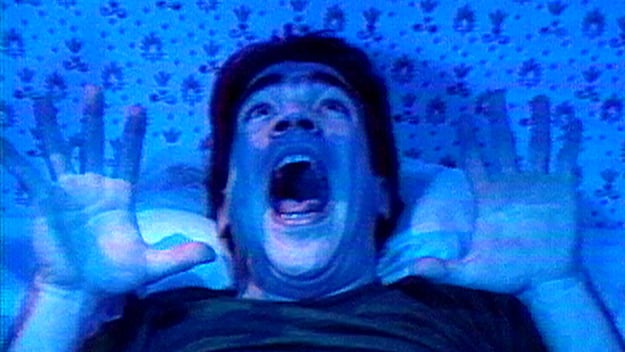
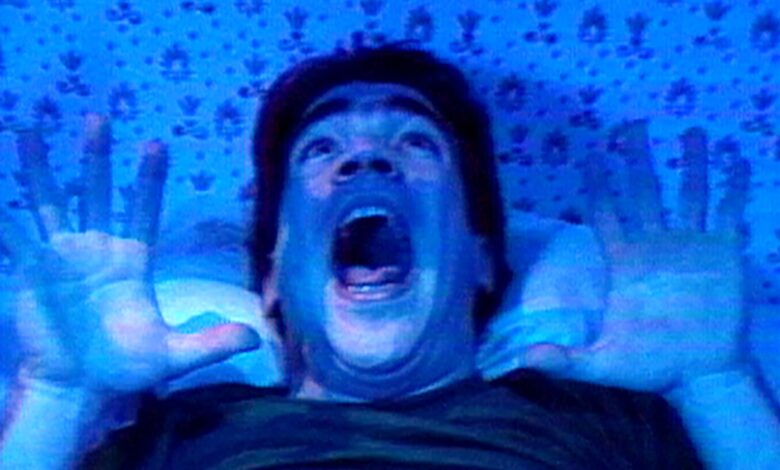
Secret Horror (Michael Smith, 1980). Courtesy Electronic Arts Intermix (EAI), New York.
“I wonder what I’ll do today?” Mike always seems to be asking himself, standing exposed in a ripped white T-shirt and oversized boxer shorts. The long-running comedic persona of performance/video/installation artist Michael Smith, Mike tries his best to get his day off to a good start, but things consistently go off the rails. He makes himself his beloved “fresh, hot cup of coffee,” but then drinks it way too fast, sending him straight to the toilet. He diligently irons his business shirts, only to discover they’re stained with huge splotches of pen ink. Mike lives in a near-constant state of bafflement, sauntering from one failed activity to the next. Yet despite all his setbacks, he never loses his wide-eyed enthusiasm for all things ordinary and mundane. “Mike’s task is to bear witness to an everyday world,” a movie trailer–style narrator with a booming baritone proclaims in Mike’s World (2007), an “orientation video” for Mike’s semi-charmed, semi-cursed kind of life. “What does this world ask of Mike? Nothing less than a total commitment to puttering, hoping, tinkering, more hoping, dabbling, and, of course, wondering.”
MIKE’S BOX, a new eight-disc DVD collection released by the long-running Chicago independent record label Drag City and co–executive produced by the musician Jim O’Rourke, charts nearly five decades of Mike’s commitment to puttering, tinkering, and wondering—and, behind it all, Smith’s enduring interest in exploring the strange psychology of his hapless everyman. The box brings together Smith’s explorations across contexts (alternative performance spaces and comedy clubs, public-access and mainstream TV, galleries and museums) as well as shifting historical moments (defined in Mike’s world as the heady disco days of the ’70s, the austerity and conservatism of the Reagan years, the entrepreneurial swagger of the ’90s, and a present day filled with selfie sticks and camera-off Zoom calls). It also presents much of Smith’s non-Mike-centered work—including videos documenting his other major character, Baby Ikki, a genderless and speechless toddler who anarchically crawls around public spaces; as well as Doug and Mike’s Adult Entertainment, a gonzo puppet show he co-produced with Doug Skinner throughout the ’90s.
Smith was born in Chicago in 1951, and first trained as an abstract painter before emerging in mid-’70s downtown New York just after an initial wave of conceptual and performance art had begun to settle into its various strains and camps. His early work particularly channels the process-oriented films and videos of Bruce Nauman, in which the artist puts himself through repetitious tasks around his studio, and the mixed-media barrage of Richard Foreman’s Ontological-Hysteric Theater. Yet he was also captivated by the pop culture of his postwar Midwestern childhood—TV variety and game shows, sitcoms and westerns, kitschy kid’s records, and absurdist stand-up routines by comics like Jackie Vernon and Shelley Berman. Smith originally conceived of Mike as a character called “Blandman,” a Samuel Beckett–influenced attempt to strip a neutral middle-class American man down to his barest cultural components—a struggling but striving bachelor living alone in his apartment. Channeling Nauman, Smith would later describe his work as “an avant-garde performance transformed into a domestic task.”
At the heart of Mike’s domestic life is the television set, the piece of furniture that defines the architecture of the eternal living room he inhabits, and which also functions as a portal to an outside world that both inspires and terrifies him. Often, the TV signal seems to get jumbled and the boundaries between Mike’s private life and the public broadcast become blurred. In Down in the Rec Room (1979), Mike enjoys tuning into Donny and Marie Osmond’s variety show to practice his impressively lithe disco dance moves, but his world is thrown into crisis when the TV at his laundromat eerily broadcasts his apartment’s commode for all to see: “What’s my toilet doing on the television?” he mutters in embarrassed disbelief. In Secret Horror (1980), Smith’s first work designed entirely for video rather than live performance, Mike wants only to channel-surf in his boxers while eating his favorite snack mix, but a group of ghosts invades his home and kidnaps him, taking him to a television studio where he must participate in a game show based on correctly identifying his household appliances.
While Smith’s works share a hilariously absurd tone, they also frequently disturb, tapping into a weird, ineffable zone between commercial media and real life. As the curator Jay Sanders somewhat facetiously exclaimed in a 2007 discussion, “‘Mike’ is both the medium and the message!” But it’s only partly a joke, as the subjects of Smith’s critique are not just the mechanics of the television broadcast or the psychology of the average American man, but also the way in which media warps our lives, influencing our routines, beliefs, and identities in ever more dehumanizing ways. Sometimes Mike appears as the media’s naïve and docile victim, a man whose only crime is to accept at face value everything the TV ever told him. Other times, he’s something more uncanny—a strange embodiment in human form of the logic of commercial television, a terrifying mirror reflection that forces us to reckon with what the media we consume values, commodifies, and normalizes.
Smith’s irreverent tone and transgressive spirit point back to a time when the boundaries between underground and mainstream culture, reflected by the democratizing promise of public-access television, were fascinatingly porous. In recent years, he’s remained primarily known within the contemporary art world, but his work deserves broader recognition. That’s a major reason why the deluxe DVD box set is such a fitting form in which to present his life’s work. On the one hand, you could think of this over-the-top project as just the type of failed, behind-the-times business venture Mike the character himself would come up with. But it’s also a stealthy way for Smith’s work to circulate beyond the gallery and museum, making it available to view in living rooms and basements everywhere. Now, finally, we all can sit at home, snack mix in hand, and watch Mike watch Mike on TV. What could be a better way to spend your day?
Source link